
You start creatine.
You train harder.
Your strength shoots up.
And then — the scale jumps.
Suddenly, doubts creep in:
- Am I gaining fat?
- Is creatine causing bloating?
- Should I stop before it ruins my physique?
If you’ve asked these questions, you’re not alone. Creatine is one of the most researched supplements in the world — and also one of the most misunderstood.
Let’s break down what creatine really does to your body, why weight gain happens, and why — in most cases — it’s actually a sign that creatine is working.
What Is Creatine (And Why Your Body Loves It)?
Creatine is a naturally occurring compound stored in your muscles. About 95% of it lives inside muscle cells, where it plays one critical role:
👉 Fast energy production.
During high-intensity activities like lifting, sprinting, or HIIT, creatine helps regenerate ATP — the body’s primary energy currency. More creatine = more ATP = better performance.
Your body produces some creatine on its own, and you get small amounts from red meat and fish. But supplementation significantly increases muscle creatine stores — which is where the real benefits begin.
Does Creatine Cause Weight Gain? (Short Answer)
Yes — but not the kind you’re afraid of.
Creatine weight gain comes from:
- Water stored inside muscles (short-term)
- Actual lean muscle growth (long-term)
It does not directly cause fat gain.
Let’s break this down clearly.
1. The First Weight Jump: Water Inside Muscles (Not Bloating)
Most people notice weight gain within the first 5–10 days of starting creatine.
What’s really happening?
Creatine pulls water into muscle cells, increasing intracellular hydration.
- Typical increase: 0.5–1.5 kg (1–3 lbs)
- Happens early
- Plateaus quickly
- Water is stored inside muscle, not under the skin
What it looks like
✔️ Muscles appear fuller
✔️ Strength feels better
❌ No soft bloating
❌ No puffiness
This is why creatine often improves muscle “pump” and definition rather than making you look bulky.
Important: About 15–20% of people are “low responders” and may see little scale change. That’s normal.
2. The Real Gain: Lean Muscle Over Time
This is where creatine truly shines.
Creatine allows you to:
- Lift heavier
- Do more reps
- Recover faster between sets
Over weeks, this leads to greater muscle protein synthesis.
What the scale reflects over time:
- 0.5–2 kg (1–4 lbs) of lean muscle
- Appears over 4–12 weeks
- Only happens if you train consistently
This is real tissue gain, not water.
Does Creatine Cause Fat Gain?
No — not directly.
Creatine:
- Has zero calories
- Does not affect insulin negatively
- Does not increase fat storage hormones
Fat gain only occurs if:
- You eat far beyond your calorie needs
- Appetite increases and calories aren’t tracked
👉 The supplement isn’t the problem. Diet management is.
Why Creatine Improves More Than Just Muscle
Creatine’s benefits go far beyond the scale:
- Strength gains: 5–15% increase in major lifts
- Better training volume: 10–20% more reps per session
- Faster recovery: Reduced muscle soreness and fatigue
- Improved power output: Especially for explosive movements
- Cognitive support: Better focus under mental stress
This is why creatine is used by athletes, gym-goers, and even older adults.
How to Use Creatine Without Unwanted Weight Confusion
The Optimal Daily Dose
- 3–5 g per day
- No loading phase required
- Consistency matters more than timing
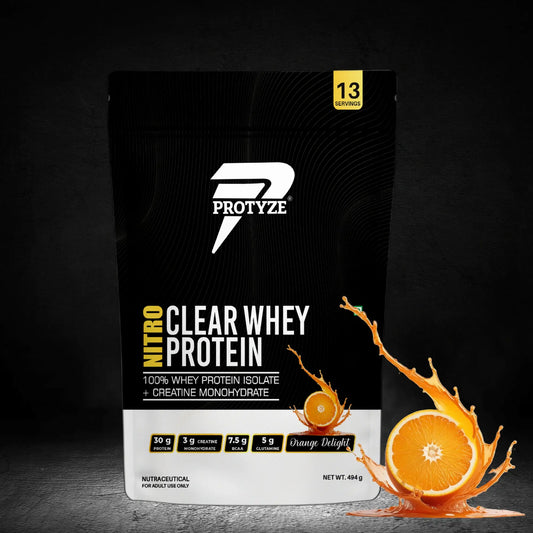
If you prefer convenience, Protyze Nitro Clear Whey provides 3 g of creatine per scoop in a light, water-based format — making it easier to digest and easier to stick with daily.
Best Time to Take Creatine
- Post-workout with protein and carbs (ideal)
- Any time on rest days
- Timing is flexible — daily intake matters most
Hydration Matters
Creatine increases water demand inside muscles.
✔️ Add 500–700 ml extra water daily
✔️ Especially important in hot climates and intense training phases
Managing the Scale Like a Pro
If you’re using creatine, don’t let the scale mislead you.
Instead, track:
- Strength progression
- Workout performance
- Muscle measurements
- Progress photos
The scale alone doesn’t tell the full story — especially with creatine.
Common Creatine Myths (Finally Explained)
Myth: Creatine causes bloating
→ False. Water is stored inside muscle cells, not under the skin.
Myth: Creatine damages kidneys
→ False in healthy individuals at recommended doses.
Myth: Creatine is only for men
→ False. Women benefit equally in strength and lean mass.
Myth: You lose muscle when you stop creatine
→ False. You only lose excess water, not trained muscle.
Final Verdict: Should You Worry About Creatine Weight Gain?
No — you should understand it, not fear it.
Creatine weight gain means:
- Your muscles are hydrated
- Your training capacity is improving
- Your body is adapting positively
When used correctly, creatine:
- Does not cause fat gain
- Does not cause bloating
- Does support real muscle growth
If your goal is strength, lean muscle, and performance, creatine isn’t the problem — it’s one of the best tools you can use.
TL;DR
- Creatine may increase weight 1–3 lbs initially from muscle water
- Long-term gain (1–4 lbs) is lean muscle, not fat
- Take 3–5 g daily (Protyze Nitro Clear Whey delivers 3 g)
- Stay hydrated, train hard, and ignore short-term scale noise
The scale going up isn’t failure — it’s feedback.
FAQ'S
1. Does creatine cause fat gain or just weight gain?
Creatine does not cause fat gain. When using Protyze Nitro Clear Whey, the weight increase comes from muscle hydration and lean muscle growth, not fat storage.
2. Why does my weight increase after starting creatine?
Creatine in Protyze Nitro Clear Whey pulls water into muscle cells and improves workout performance, which leads to temporary water weight and better muscle gains.
3. How much weight do you gain on creatine?
With Protyze creatine intake (3 g daily), most people gain 1–3 lbs initially from water and 1–4 lbs of lean muscle over time with consistent training.
4. Does creatine cause bloating or a puffy look?
No. Creatine from Protyze Nitro Clear Whey stores water inside muscles, enhancing muscle fullness without causing bloating or puffiness.
5. Is creatine safe for daily use?
Yes. Daily creatine use at 3–5 g, like the dose in Protyze Nitro Clear Whey, is safe and well-researched for healthy individuals.
6. Do women gain weight from creatine?
Women using Protyze creatine may see a small weight increase from muscle hydration and strength gains, not fat or bulkiness.
7. How long does creatine water weight last?
When using Protyze Nitro Clear Whey, creatine-related water weight typically stabilizes within 7–14 days, after which gains reflect real muscle growth.
8. Should I stop creatine if the scale goes up?
No. A rising scale after starting Protyze creatine usually means positive muscle adaptation, not unhealthy weight gain.
9. What is the best dose of creatine to avoid bloating?
A daily dose of 3–5 g, like the 3 g provided in Protyze Nitro Clear Whey, is ideal to avoid digestive discomfort and excess water retention.