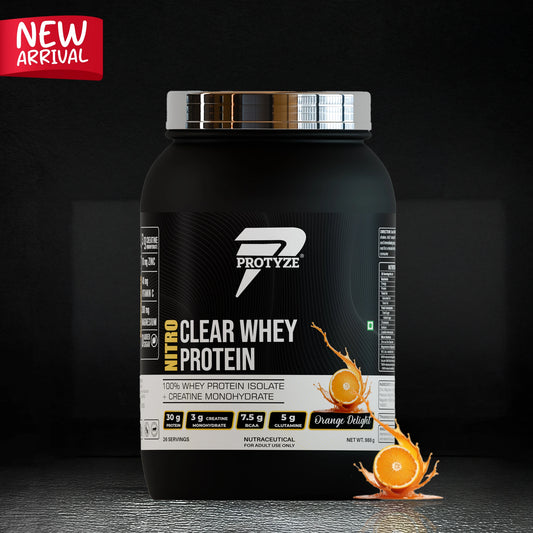

Clear whey and traditional whey protein can both help you increase your protein intake, but they aren't designed to deliver the same drinking experience.
One is typically light and juice-like. The other is usually creamy and shake-like.
So which should you choose?
The answer depends less on which one is "better" and more on which format fits your diet, preferences and routine.
Clear Whey vs Whey Protein: Quick Answer
Both can provide high-quality whey protein.
The biggest differences are:
- Texture
- Appearance
- Formulation
- Protein source
- Ingredients
- Taste
- Drinking experience
Clear whey is typically designed as a light, fruit-flavoured drink, while traditional whey is generally designed as a creamy shake.
Clear Whey vs Traditional Whey: Comparison
| Factor | Clear Whey | Traditional Whey |
|---|---|---|
| Texture | Light | Creamy |
| Appearance | Clear/translucent | Opaque |
| Typical taste | Fruity | Creamy/milky |
| Protein source | Often WPI | WPC, WPI or blend |
| Mixes with | Usually water | Water or milk |
| Drinking experience | Juice-like | Shake-like |
| Best suited to | People wanting a refreshing protein drink | People who prefer creamy shakes |
The exact nutritional values depend on the individual product.
1. Protein Quality
Clear whey does not automatically mean higher-quality protein.
The quality depends on the protein ingredient and formulation.
Many clear whey products use whey protein isolate, while traditional whey products can contain whey concentrate, whey isolate or a combination.
Therefore, don't judge protein quality simply by whether the powder produces a clear drink.
Check the nutrition panel and ingredient list.
2. Texture and Taste
This is where the biggest practical difference appears.
Traditional whey is usually creamy.
Clear whey is formulated to be lighter and more refreshing.
If you enjoy milkshake-style flavours, traditional whey may suit you.
If you prefer fruit drinks, clear whey may be easier to incorporate into your routine.
3. Lactose
Lactose content depends on the protein source and final formulation.
Whey protein isolate generally contains less lactose than whey concentrate.
However, "low lactose" and "lactose-free" should not be used interchangeably.
Always check the manufacturer's nutrition and allergen information.
4. Calories, Carbohydrates and Fat
Don't assume that every clear whey is automatically lower in calories than every traditional whey.
The nutritional profile depends on:
- Protein source
- Serving size
- Sweeteners
- Added ingredients
- Flavouring
- Carbohydrates
- Fat
Compare the actual nutrition labels of the products you're considering.
5. Digestion and Comfort
This is an area where individual tolerance matters.
Some people find creamy protein shakes heavy, while others have no issue consuming them.
A clear whey formulation may feel lighter because of its water-based, non-creamy format.
However, it would be inaccurate to claim that every clear whey protein is automatically easier to digest for everyone.
Your individual tolerance matters.
6. Muscle Growth and Recovery
Both clear whey and traditional whey can provide the amino acids required to support muscle protein synthesis and recovery.
Your results are influenced by much more than protein format:
- Total daily protein intake
- Resistance training
- Overall calorie intake
- Sleep
- Recovery
- Consistency
The clear format itself doesn't make a protein magically better for building muscle.
Clear Whey vs Whey: Which One Should You Choose?
Choose clear whey if you:
- Prefer fruit flavours
- Dislike creamy protein shakes
- Want a lighter drinking experience
- Train in hot weather
- Prefer mixing protein with water
- Want more variety in your protein routine
Choose traditional whey if you:
- Prefer creamy shakes
- Enjoy milkshake-style flavours
- Want a more filling protein drink
- Like mixing protein with milk or smoothies
Can You Use Both?
Absolutely.
There is no nutritional rule that says you must use only one format.
For example, you might prefer:
Traditional whey → breakfast smoothie
Clear whey → post-workout or afternoon drink
The best option is the one that helps you consistently meet your nutritional requirements.
Frequently Asked Questions
Is clear whey better than regular whey?
Not universally. Clear whey provides a different drinking experience, while both formats can provide high-quality protein.
Does clear whey build muscle?
Yes, clear whey can contribute to muscle growth when it provides adequate protein and is combined with appropriate resistance training and overall nutrition.
Is clear whey easier to digest?
Some people prefer its lighter format, but individual digestion varies. The protein source and ingredients also matter.
Which is better for weight loss?
Neither automatically causes weight loss. Body-fat reduction depends primarily on overall energy balance and diet. Protein can be useful as part of a structured weight-management diet.
Can I take clear whey and regular whey together?
Yes. They can both be included in the same diet if your total protein intake and overall nutrition are appropriate.
Final Verdict
There is no universal winner.
Clear whey wins on drinking experience for people who prefer light, fruity protein drinks.
Traditional whey wins for people who prefer creamy, shake-style protein.
Instead of asking "Which protein is better?", ask:
Which protein can I comfortably and consistently include in my diet?
For the science behind how clear whey is produced, continue to:
The Science Behind Clear Whey Protein: How It Works