
You’ve probably noticed it yourself: after a brutal leg day (squats, deadlifts, lunges, leg press), you feel hungrier, sorer, more drained, and take longer to recover than after a chest, back, or arm session, even when the perceived effort or total sets/reps feel similar. This isn’t random or psychological. Leg training creates a significantly larger demand for dietary protein than upper-body work. The difference is real, measurable, and rooted in physiology. Here’s the detailed science behind why legs need more whey protein and creatine for optimal recovery and growth and how to adjust your nutrition accordingly in 2026.
1. Legs Train Much Larger Muscle Mass
The lower body contains the largest and most powerful muscles in the human body:
- Quadriceps group (vastus lateralis, rectus femoris, vastus medialis, vastus intermedius)
- Gluteus maximus (one of the strongest muscles per square inch)
- Hamstrings (biceps femoris, semitendinosus, semimembranosus)
- Adductors, abductors, calves, and spinal erectors (heavily recruited in squats and deadlifts)
Together, these account for 50–60 % of total skeletal muscle mass in most people roughly double the combined mass of chest, shoulders, arms, upper back, and core. Larger muscle mass = more muscle fibres recruited and damaged during eccentric loading → significantly greater need for amino acids to repair micro-tears and rebuild stronger tissue. Practical impact: A heavy leg session creates 2–3 times more muscle damage than an equivalent upper-body session → requires proportionally more dietary protein for repair.
2. Greater Mechanical Tension & Metabolic Stress
Leg exercises — especially heavy compound movements — impose extreme mechanical tension and metabolic stress:
- Squats, deadlifts, and lunges recruit hundreds of thousands of motor units across multiple large joints
- Massive systemic hormonal response (acute spikes in testosterone, growth hormone, IGF-1)
- Extreme lactate buildup and oxidative stress from high-rep sets and long time under tension
- Longer ranges of motion and higher loads than most upper-body exercises
All these factors amplify muscle protein breakdown (MPB) during training and increase the subsequent demand for muscle protein synthesis (MPS) to repair and supercompensate. Studies consistently show lower-body sessions produce 30–60 % higher MPS rates than upper-body sessions of similar relative intensity and volume (e.g., 2023 meta-analysis in Journal of Applied Physiology, 2025 review in Sports Medicine). Practical impact: Legs need more leucine (2.5–3 g per meal) and total amino acids to fully trigger MPS after training.
3. Higher Glycogen Depletion & Energy Demand
Leg workouts are extremely glycogen-depleting:
- A heavy squat or deadlift session can use 30–50 % of total muscle glycogen stores
- Glycogen depletion signals greater muscle damage and increases repair needs
- Refilling glycogen requires insulin + amino acids → protein becomes more critical post-leg day to prevent muscle catabolism
Upper-body workouts (bench press, rows, overhead press) rarely deplete glycogen to the same degree unless volume is enormous or training is protracted. Practical impact: After legs, your body needs more carbs + protein to restore glycogen and prevent breakdown, a higher protein meal post-leg day is essential.
4. Larger Systemic & Hormonal Stress Response
Leg training creates a systemic stress response far beyond local muscle damage:
- Greater cortisol and inflammatory cytokine release
- Larger drop in testosterone post-workout
- More overall central nervous system (CNS) fatigue
- Higher whole-body protein turnover
This systemic load increases the demand for dietary protein to meet elevated repair needs across the entire body, not just the legs. Upper-body training is usually more “local”, less hormonal disruption, less CNS fatigue, less systemic inflammation. Practical impact: Even if you train upper body hard, legs create a bigger “whole-body repair bill”, so you need more total protein on leg days.
Practical Recommendations for Indian Gym-Goers in 2026
Protein Intake Adjustments for Leg Days
- Same-day target: 40–60 g high-quality protein within 2 hours post-leg workout
- Daily target on leg days: 2.0–2.4 g/kg (140–190 g for 70 kg person)
- Best sources: whey isolate/clear whey (fastest MPS spike), eggs, chicken, paneer, soya
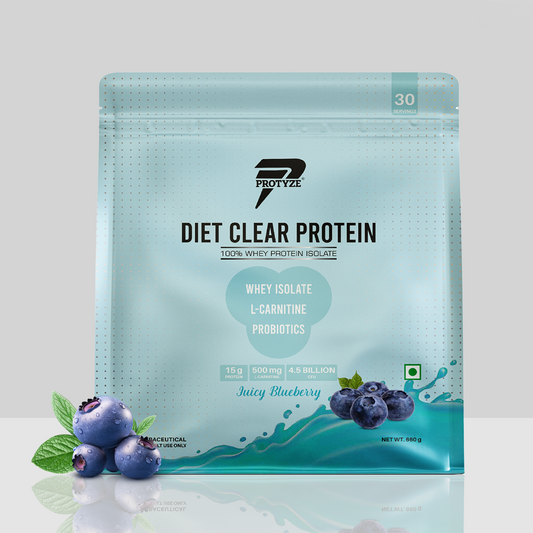
Best post-leg drink: 1–2 scoops Protyze Nitro Clear Whey (30–60 g protein) + banana or dates → fast-digesting, zero bloat, high leucine
Protein Timing Around Leg Days
- Pre-workout (1–2 hours): 30–40 g protein + carbs
- Intra-workout (if session >90 min): BCAAs or EAA sip
- Post-workout (0–2 hours): 40–60 g protein + carbs
- Before bed: slow-digesting protein (curd, paneer, casein) → overnight repair
Conclusion
Leg workouts demand more protein than upper-body training because they:
- Train 50–60 % more muscle mass
- Create greater mechanical tension & metabolic stress
- Deplete more glycogen
- Trigger a larger systemic hormonal/inflammatory response
If you’re training legs hard but recovering slowly, feeling extra sore, or stalling, increase post-leg-day protein to 40–60 g immediately after (Protyze Nitro Clear Whey is ideal), and push daily total to 2.0–2.4 g/kg on leg days. Do this consistently, and your legs will grow faster, recover quicker, and carry less stubborn fat.
TL;DR
Leg training demands more protein because it works 50–60 % more muscle mass, creates greater tension/stress, depletes more glycogen, and causes bigger systemic load. Solution: 40–60 g protein post-leg day + 2.0–2.4 g/kg total on leg days → faster recovery, more growth. Best tool: Protyze Nitro Clear Whey (30 g protein/scoop, zero bloat).