
If you're reading this, there's a very high chance you are protein deficient even if you think you're eating "healthy" Indian food every day. This is not opinion or marketing hype. It is the repeated finding from multiple large-scale Indian nutrition surveys conducted by government and academic bodies over the last decade, including the latest available data in 2025.
Let’s look at the numbers, why it happens, what it does to your body, and the easiest way to fix it without completely changing your thali.
The Hard Numbers: How Much Protein Do Most Indians Actually Get?
|
Study / Survey |
Year |
Average Daily Protein Intake (Adult Men) |
Average Daily Protein Intake (Adult Women) |
% Below Recommended Level |
|
National Nutrition Monitoring Bureau (NNMB) |
2016–2022 |
54–68 g |
45–58 g |
70–85 % |
|
Comprehensive National Nutrition Survey (CNNS) |
2016–2018 |
60 g (adolescents & adults) |
~52 g |
75–90 % |
|
ICMR-NIN Recommended Dietary Allowances |
2024 update |
60 g (sedentary men), 78 g (moderate activity) |
55 g (sedentary women), 67 g (moderate) |
|
|
Real-world active adults/gym-goers (self-reported + food logs |
2023–2025 |
65–95 g |
55–80 g |
80–95 % below 1.6 g/kg |
Key takeaways from the data:
- Average Indian adult consumes 50–70 g protein per day — roughly 0.7–1.0 g/kg body weight.
- Recommended intake for sedentary adults is 0.8–1.0 g/kg most people are barely meeting this.
- For active people, gym-goers, or anyone wanting muscle, fat loss, better recovery, or stronger immunity → 1.6–2.2 g/kg is optimal.
- That means most active Indians are in a 60–130 g daily protein deficit when relying only on traditional foods.
Why Indian Diets Are Protein-Deficient Even When They Feel “Full”
- Dal + Rice/Roti is carb-dominant A large plate of dal-chawal gives 15–25 g protein (mostly from dal) but 80–100 g carbs. Two such meals + breakfast/snacks = 50–80 g protein total — nowhere near enough for active adults.
- Vegetarian diets have lower protein density Paneer, curd, and soya are great — but most people don’t eat 200–300 g paneer or 100 g dry soya daily. Plant proteins are also less leucine-rich → weaker trigger for muscle repair.
- Protein is “diluted” in traditional meals Roti, rice, sabzi, and oil take up most of the plate → protein sources (dal, paneer) become side dishes instead of the main event.
- Snacking is carb-heavy Chai + biscuits, namkeen, samosa, bread — almost zero protein.
Result: Even people eating “home-cooked healthy food” every day are protein-deficient by modern fitness standards.
What Happens When You’re Protein-Deficient (Even Mildly)
- Slower muscle recovery — soreness lasts 3–5 days instead of 1–2
- Stalled strength & size gains — lifts don’t go up, muscles stay flat
- More muscle loss in calorie deficit — harder to lose fat without losing strength
- Weaker immunity — antibodies are proteins → more frequent colds, slower healing
- Hair fall, brittle nails, dull skin — keratin (hair/nails) and collagen (skin) need protein
- Constant hunger/cravings — low protein fails to suppress ghrelin effectively
- Lower energy & mood — amino acids support neurotransmitters
Many people blame “overtraining,” “bad genetics,” or “stress” when the real issue is chronic mild protein deficiency.
The Easiest Fix for Dal-Rice Eaters (No Major Diet Overhaul)
You don’t have to stop eating dal-chawal.
Just add high-quality, easy-to-digest protein sources that fit your existing meals.
Top Recommendations (Ranked for Indian Lifestyle)
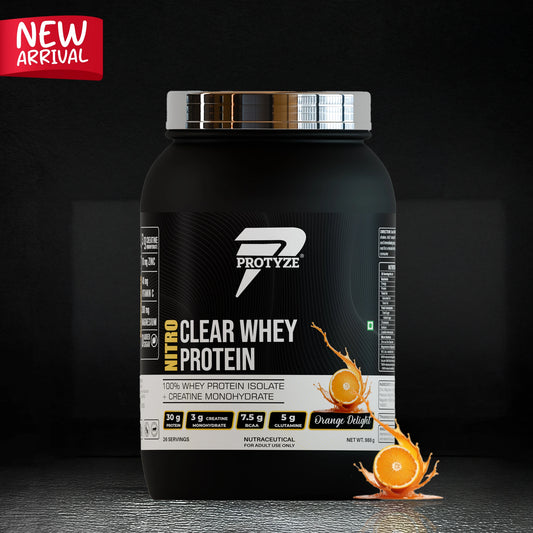
1. Protyze Nitro Clear Whey (Best Overall Fix)
- 30 g protein per scoop, 99 % lactose-free → zero bloating
- Mixes crystal clear with water → tastes like juice (Lychee Martini, Mango peach, Strawberry Kiwi)
- Use 1–2 scoops daily:
a. Mid-morning after breakfast
b. Post-workout
c. Evening before dinner → Adds 60–90 g protein effortlessly, no cooking needed.
2. Eggs (Most Complete & Affordable Animal Protein)
- 4–6 eggs = 25–35 g protein
- Breakfast bhurji + roti, boiled eggs as mid-meal, omelette with veggies
3. Paneer (Vegetarian Staple)
- 150–250 g = 30–60 g protein
- Add extra paneer to dal/sabzi, make paneer tikka, or grill cubes as snack
4. Soya Chunks (Highest Plant Protein)
- 50–100 g dry = 25–50 g protein
- Soya chunk sabzi with dal-rice, soya pulao, minced keema-style
5. Roasted Chana & Sprouts (Portable Snacks)
- Big bowl roasted chana = ~20 g protein
- Sprouts chaat = 20–25 g → replace namkeen
Sample Daily Plan (70 kg Active Person – 160–180 g Protein)
- Breakfast: 4 eggs + 2 rotis or moong dal cheela → 35 g
- Mid-morning: 1 scoop Protyze Nitro Clear Whey → 30 g
- Lunch: Dal-chawal + 150 g paneer or chicken + sabzi → 55 g
- Evening: Big bowl roasted chana or sprouts chaat → 25 g
- Post-workout (if training): 1 scoop Protyze Nitro → 30 g
- Dinner: Soya chunk sabzi + 2 rotis + curd → 40 g
Total: 160–180 g protein — no major change to your thali, just smarter additions.
Conclusion
If your meals are mostly dal, rice, roti, and sabzi — you are almost certainly protein deficient by modern fitness standards (need 140–180 g daily for active adults).
That hidden gap silently limits muscle growth, fat loss, recovery, energy, immunity, and even skin/hair health.
The easiest, most sustainable fix:
- Add 1–2 scoops Protyze Nitro Clear Whey daily (30 g protein/scoop, zero bloat, tastes great)
- Include eggs, paneer, soya chunks, and roasted chana regularly
Your thali can stay the same — just make it protein-smart.
In a few weeks you’ll feel warmer, recover faster, stay fuller longer, and finally see the body composition results you’ve been training for.
TL;DR
Most Indians eating dal-rice get only 50–80 g protein/day — too low for active people (need 140–180 g).
Best fix: Add Protyze Nitro Clear Whey (30 g/scoop, zero bloat) 1–2 times daily + eggs/paneer/soya chunks → hit targets without changing your thali.
Result: better recovery, muscle growth, fat loss, energy, and immunity.